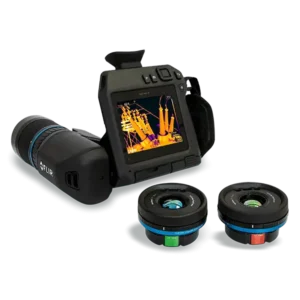
FLIR GF77 Gas Find IR Camera
The FLIR GF77 is a groundbreaking uncooled optical gas imaging (OGI) camera that helps
users visualize and locate methane and other industrial gas leaks while also serving
as a high‑performance thermal imaging camera.[web:53][web:57]
Built on the award‑winning FLIR T‑Series platform with a 320 × 240 microbolometer
detector and interchangeable gas‑specific lenses, the GF77 is ideal for electric
utilities, oil & gas, chemical and manufacturing plants, food and agriculture,
and emergency response teams.[web:55][web:57][web:60]

Key features
- Uncooled 320 × 240 detector – sensitive uncooled microbolometer
for gas imaging and thermal inspections without the cost and maintenance of a
cooled detector system.[web:55][web:59] - Dual‑use: gas detection & thermography – detects gas plumes
with dedicated gas lenses and also measures temperature for mechanical,
electrical and process inspections.[web:55][web:57][web:60] - Gas‑specific lens options – LR (low‑range) and HR (high‑range)
lenses optimized for different gases including methane (CH₄), nitrous oxide (N₂O),
propane, sulfur dioxide (SO₂), R‑134a, R‑152a, sulfur hexafluoride (SF₆), ammonia
(NH₃) and ethylene (C₂H₄), depending on configuration.[web:55][web:57] - Ergonomic rotating optical block – 180° rotating optics make it
easier to inspect difficult‑to‑reach components above or below eye level while
maintaining a comfortable posture.[web:58][web:59] - 4″ touchscreen LCD with auto‑rotation – bright 640 × 480
touchscreen display and integrated viewfinder provide clear visualization of gas
plumes and thermal scenes, indoors and outdoors.[web:55][web:58] - Laser‑assisted autofocus – built‑in laser distance measurement
supports continuous and one‑shot autofocus for sharp images on complex targets.[web:55][web:59][web:61] - High‑sensitivity mode (HSM) – image processing that enhances
plume motion and contrast, improving gas leak detectability against challenging
backgrounds.[web:57][web:61] - 1‑Touch Level/Span – automatic contrast optimization for faster,
easier interpretation of thermal and gas images.[web:55][web:61] - Rich connectivity – USB, Wi‑Fi, Bluetooth and DisplayPort/HDMI
outputs for data transfer, remote viewing and reporting workflows.[web:55][web:59]
Typical applications
- Methane leak detection in natural gas production, processing and distribution.[web:53][web:57]
- SF₆ and other gas leak surveys in electric power substations and switchgear.[web:57][web:60]
- Fugitive emissions monitoring in refineries and petrochemical plants.[web:57][web:60]
- Refrigerant leak detection in industrial refrigeration and HVAC systems.[web:55][web:57]
- Thermal inspections of mechanical and electrical assets.[web:55][web:60]
Main benefits
- Affordable entry into optical gas imaging thanks to uncooled detector design.[web:53][web:57]
- Scan large areas quickly from a safe distance, without direct contact.[web:57][web:61]
- Reduce greenhouse gas emissions by identifying leaks early.[web:53][web:57]
- Combine gas imaging and temperature measurements in a single tool.[web:55][web:60]
- Streamline reporting with high‑quality images, video and wireless data transfer.[web:55][web:59]
Technical specifications (summary)
Detector & optics
| IR resolution | 320 × 240 pixels, uncooled microbolometer.[web:55][web:60] |
|---|---|
| Detector pitch | 25 µm.[web:55] |
| Field of view (standard lens) | 25° × 19°.[web:55][web:59] |
| Lens focal length | ≈ 18 mm, f/1.04 (typical 25° lens).[web:59] |
| Thermal sensitivity (NETD) | < 30 mK at 30 °C (typical).[web:59][web:60] |
| Gas detection (lens dependent) | LR lens: methane (CH₄), nitrous oxide (N₂O), propane, sulfur dioxide (SO₂), R‑134a, R‑152a and similar gases; HR lens: sulfur hexafluoride (SF₆), ammonia (NH₃), ethylene (C₂H₄).[web:55][web:57] |
| Digital zoom | 1–6× continuous digital zoom.[web:55][web:59] |
| Focus modes | Continuous laser distance (LDM), one‑shot LDM, one‑shot contrast and manual focus.[web:59] |
Image presentation
| Frame rate | 30 Hz (image frequency).[web:55][web:59] |
|---|---|
| Display | 4″ 640 × 480 touchscreen LCD with auto‑rotation.[web:55][web:58] |
| Viewfinder | Integrated eyepiece for bright outdoor conditions.[web:59][web:61] |
| Image modes | Thermal image, gas enhancement, High‑Sensitivity Mode (HSM).[web:57][web:61] |
| Contrast enhancement | 1‑Touch Level/Span automatic contrast optimization.[web:55][web:61] |
Temperature measurement
| Temperature range | Approx. −20 °C to 450 °C (−4 °F to 842 °F), depending on configuration.[web:55][web:60] |
|---|---|
| Accuracy | ±2 °C (±3.6 °F) or ±2% of reading (typical).[web:55][web:60] |
| Measurement tools | Up to 3 live spots and 3 areas; presets for center spot, hot spot, cold spot and user presets.[web:58] |
Communication, storage & power
| Interfaces | USB 2.0, Bluetooth, Wi‑Fi, DisplayPort/HDMI (via adapter).[web:55][web:59] |
|---|---|
| Video output | Digital video output over DisplayPort / HDMI; streaming options depend on configuration.[web:55][web:59] |
| Storage | Removable memory card storing radiometric JPEG images and non‑radiometric video.[web:55][web:58] |
| Battery | Rechargeable Li‑ion battery pack; typical operating time > 4 hours at 25 °C.[web:59][web:60] |
Physical & environmental
| Dimensions (L × W × H) | Approx. 150.5 × 201.3 × 167.3 mm.[web:62] |
|---|---|
| Operating temperature | −15 °C to +50 °C (5 °F to 122 °F).[web:62] |
| Weight | Typically around 1.8–2.1 kg depending on lens.[web:60][web:61] |
| Mounting | 1/4″‑20 UNC tripod mounting interface.[web:55] |
For complete and up‑to‑date information, consult the official FLIR GF77 datasheet and product page.[web:53][web:58][web:59]