FLIR G620 Optical Gas Imaging Camera
FLIR G620 is a portable optical gas imaging (OGI) camera for detecting and visualizing
hydrocarbon and volatile organic compound (VOC) gas leaks in refineries, petrochemical
plants, natural gas facilities, and power generation sites.[web:33][web:35]
With a cooled 640 × 480 infrared detector, high thermal sensitivity and in‑camera gas
quantification analytics, the G620 helps inspectors locate and quantify leaks quickly
while keeping a safe distance and minimizing process interruptions.[web:33][web:35]
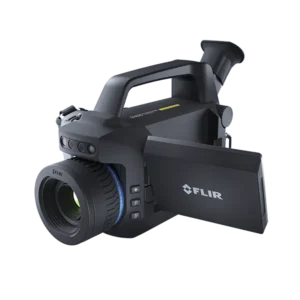
Key features
- High‑resolution OGI imaging – 640 × 480 (307,200 pixels) IR resolution
provides clear visualization of gas plumes, enabling inspectors to scan large areas from
a safe distance without stopping operations.[web:33][web:36][web:37]
- In‑camera gas quantification – built‑in analytics calculate leak size and
severity in the camera, reducing the need for secondary instruments and simplifying LDAR
documentation.[web:33][web:35]
- Cooled InSb detector with high sensitivity – cooled focal plane array and
High Sensitivity Mode (HSM) allow reliable detection of small methane and VOC leaks with
a NETD of about 20 mK at 30 °C.[web:35][web:41]
- Rotating color touchscreen and integrated viewfinder – tiltable OLED
viewfinder plus rotating LCD touchscreen improve ergonomics in tight spaces and at
different angles.[web:35][web:40]
- Digital zoom and advanced image processing – 1–8× continuous digital
zoom, noise reduction filters and HSM enhance small, low‑contrast gas plumes.[web:35]
- Robust measurement tools – multiple spot meters, area boxes with
max/min/average, profile line and measurement corrections for distance, ambient,
humidity and external optics.[web:35]
- Cloud connectivity with FLIR Ignite – images and videos can be uploaded
to the cloud for backup, organization, analysis and sharing with stakeholders.[web:35]
- Designed for industrial environments – suitable for leak detection in
refineries, petrochemical complexes, gas well pads, compressor stations and power
plants, supporting environmental compliance and safety programs.[web:33][web:35][web:39]
Typical applications
- Leak detection and repair (LDAR) programs for hydrocarbons and VOCs.[web:33][web:39]
- Fugitive emissions surveys in refineries and petrochemical plants.[web:33][web:39]
- Methane leak surveys at natural gas well pads and gathering systems.[web:33][web:39]
- Compressor station and pipeline component inspections.[web:33][web:37]
- Power generation and chemical plant emission monitoring.[web:33][web:36]
Benefits
- Reduce inspection time by scanning large areas without contact with the process.[web:35][web:37]
- Improve safety by detecting leaks from a distance and reducing exposure.[web:33][web:35]
- Support environmental compliance and reduction of greenhouse gas emissions.[web:33][web:39]
- Quantify leaks directly in the field for better maintenance prioritization.[web:35][web:37]
- Capture radiometric data and video for documentation and analysis.[web:35]
Technical specifications (summary)
Imaging & optics (24° lens)
| IR resolution |
640 × 480 pixels (FPA cooled InSb detector).[web:35][web:41] |
| Field of view (FOV) |
24° × 18° (typical lens option).[web:35] |
| Focal length |
≈ 23 mm; minimum focus distance about 0.3 m.[web:35] |
| Thermal sensitivity / NETD |
≈ 20 mK at +30 °C.[web:35][web:41] |
| Spectral range |
Approximately 3.2–3.4 µm for hydrocarbon/VOC imaging.[web:35][web:38] |
| Focus |
Autofocus and manual focus options.[web:35] |
| Digital zoom |
1–8× continuous digital zoom.[web:35] |
| Image modes |
IR image, visual image and High Sensitivity Mode (HSM).[web:35] |
| Viewfinder |
Built‑in tiltable OLED, about 800 × 480 pixels.[web:35] |
Detector & electronics
| Detector type |
Cooled InSb focal plane array (FPA).[web:35][web:38] |
| Detector pitch |
≈ 15 µm.[web:35][web:41] |
| Cooling |
Stirling micro‑cooler (e.g. FLIR MC‑3).[web:35][web:38] |
| Image enhancement |
High Sensitivity Mode, noise reduction filters.[web:35] |
Measurement & analysis
| Temperature measurement |
Radiometric IR measurement with multiple tools (spots, boxes, profiles).[web:35] |
| Spot meters |
Up to 10 spots.[web:35] |
| Area tools |
Up to 5 boxes with max/min/average values.[web:35] |
| Profile |
One horizontal or vertical line profile.[web:35] |
| Measurement corrections |
Reflected temperature, distance, transmission, humidity, external optics.[web:35] |
| Gas quantification |
On‑board quantification for hydrocarbon and VOC leaks.[web:33][web:35] |
Video, storage & connectivity
| Radiometric IR video |
Radiometric streaming and recording in proprietary format (e.g. RTRR/.csq) to memory.[web:35] |
| Non‑radiometric video |
H.264 recording to memory card for IR or visual channels.[web:35] |
| Streaming |
Radiometric streaming over UVC; additional digital outputs depending on configuration.[web:35] |
| Connectivity |
USB, networking options and cloud upload via FLIR Ignite integration.[web:33][web:35] |
Physical & power
| Camera size |
≈ 252 × 165 × 171 mm (9.9 × 6.5 × 6.7 in).[web:35] |
| Camera weight |
≈ 3.0 kg (6.6 lb).[web:35] |
| Mounting interface |
UNC ¼″‑20 tripod mount.[web:35] |
| Battery type |
Rechargeable Li‑ion, ≈ 7.4 V / 5.5 Ah.[web:35][web:38] |
| Battery operating time |
Typically > 2–2.5 hours at 25 °C with normal use.[web:35][web:38] |
For full details and latest specifications, refer to the official FLIR G‑Series documentation and datasheet.[web:33][web:38]